Posted by Mustafa Abbas on January 01, 2025 | Views: 565 | Ratings: 232





Download article from link below at the end
Please wait for pictures to download, click ">" for next picture, "<" for previous picture or wait for pictures to play in slideshow.
Man Look to His Food: A Comprehensive Reflection on Sustenance, Divine Power, and Resurrection
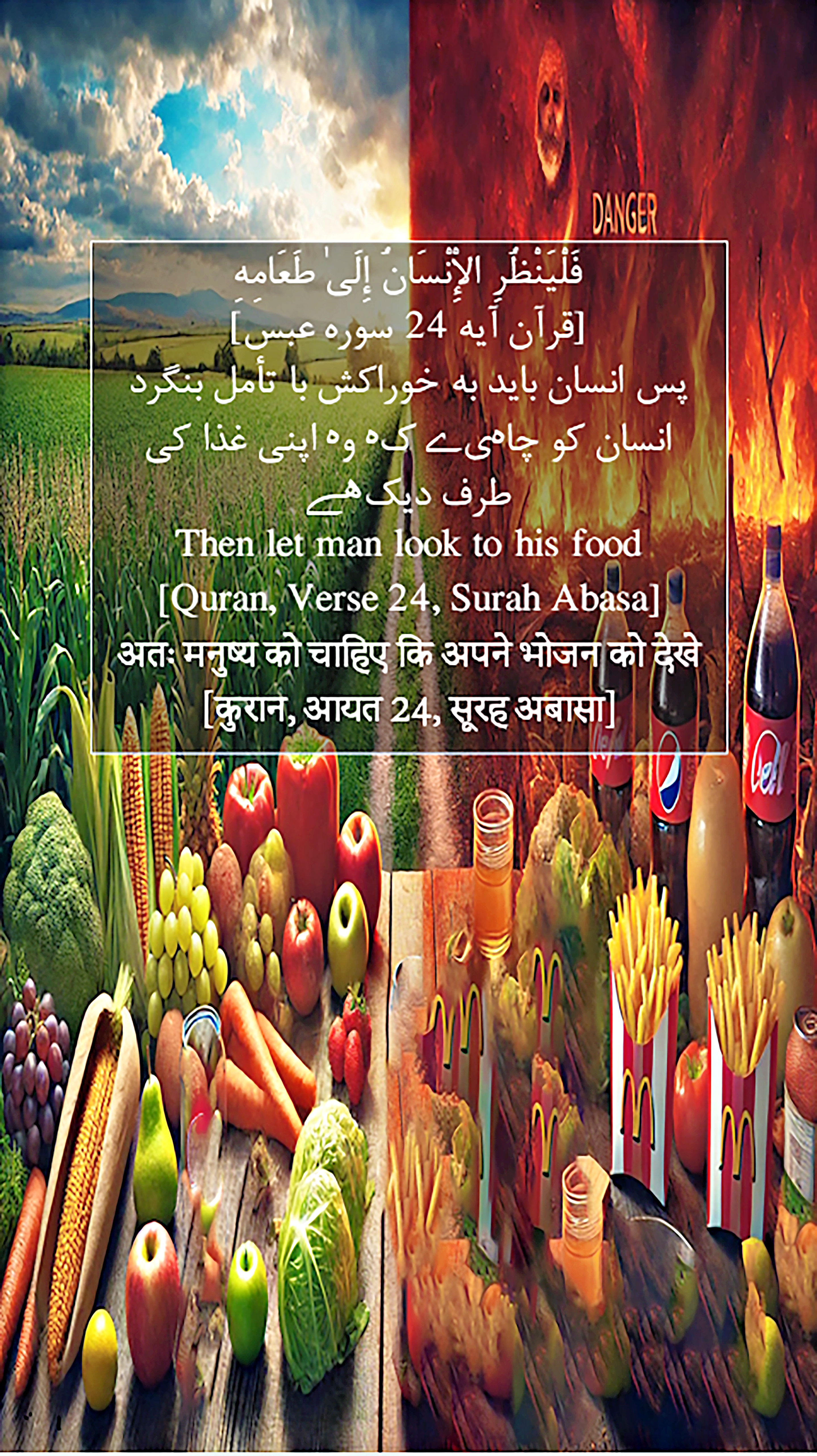
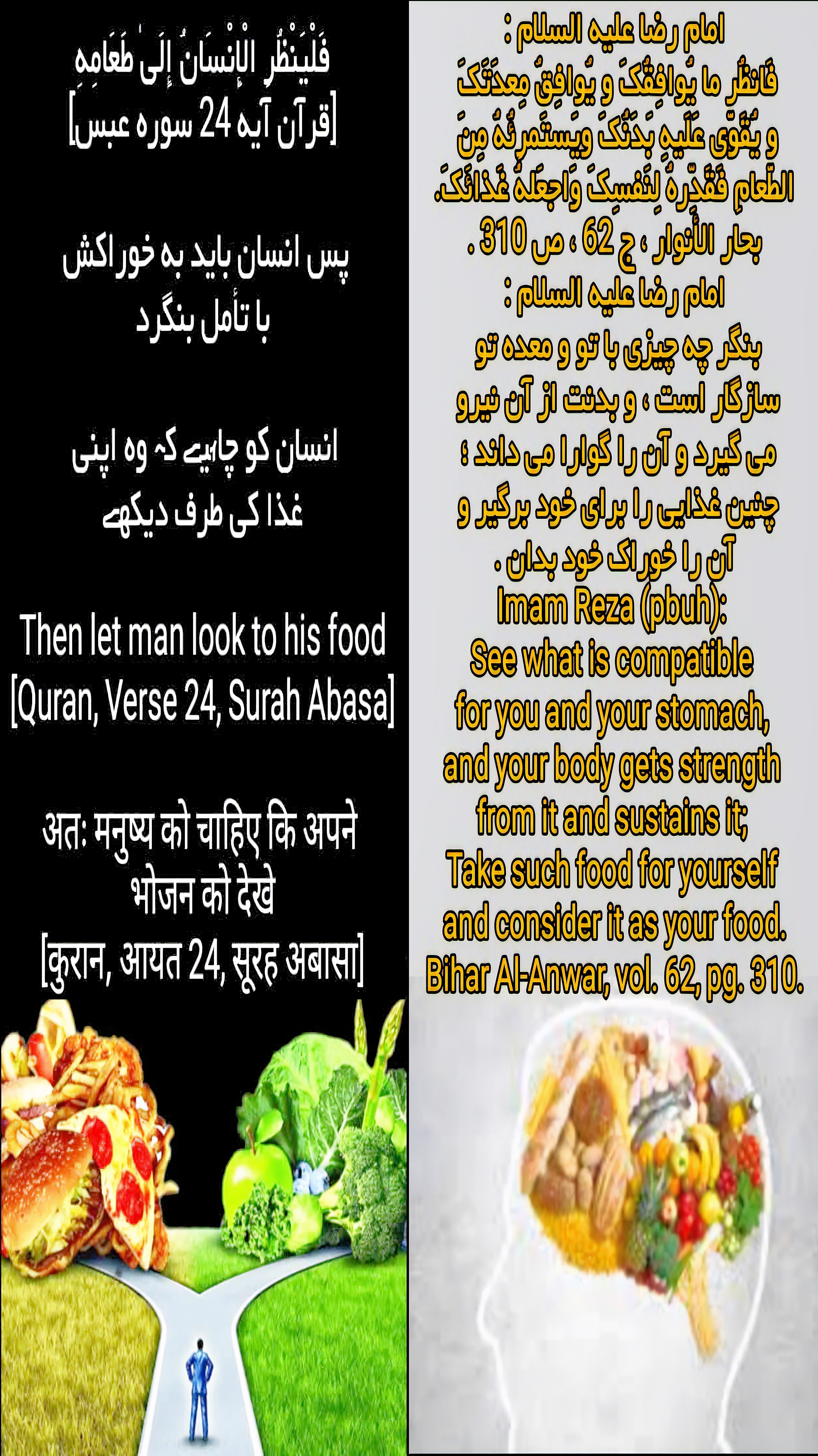
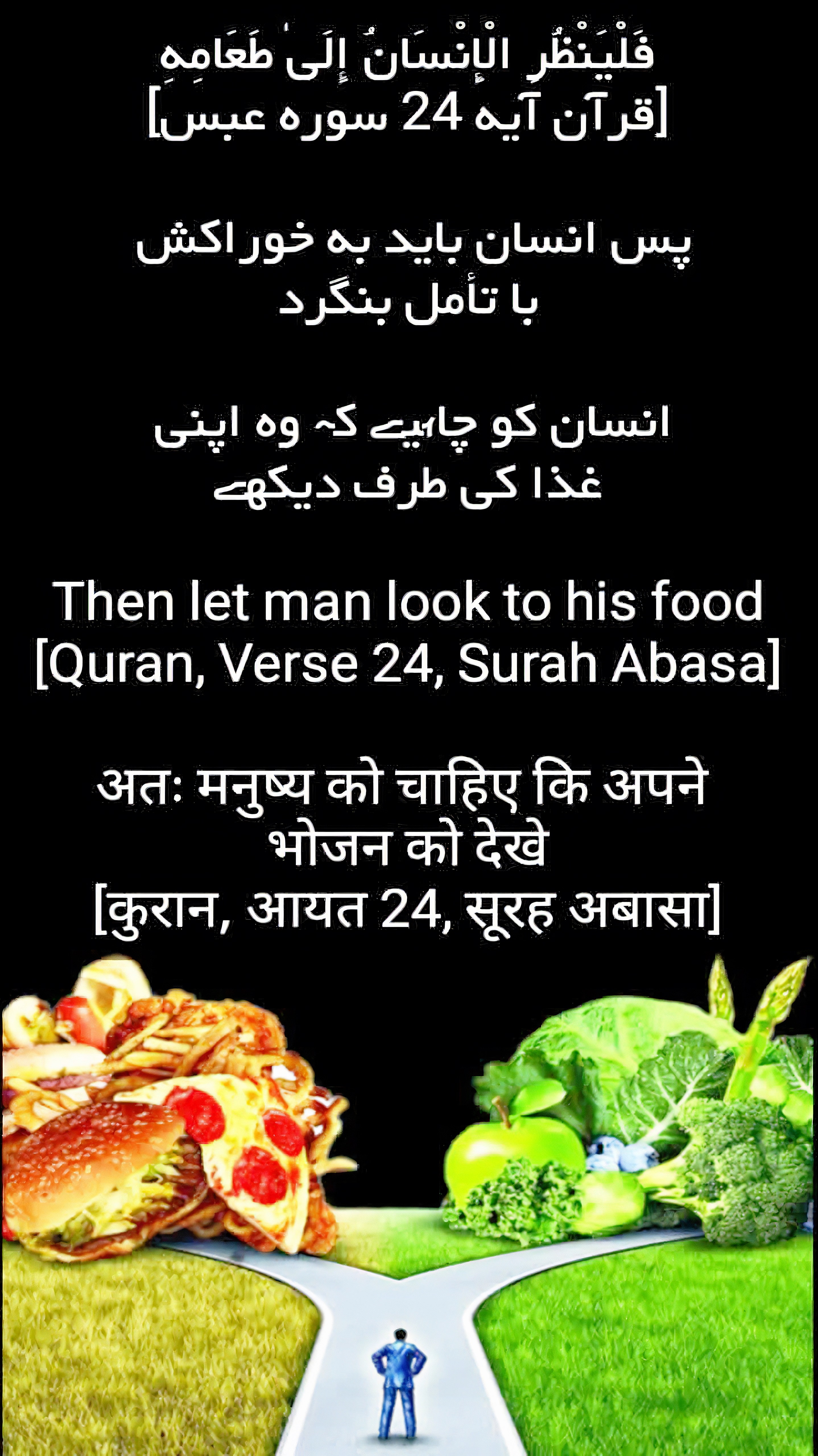
The Quranic verse "Then let man look to his food", found in Surah Abasa (Quran 80:24), stands as one of the most profound invitations to reflection in Islamic scripture. At first glance, it appears to be a simple directive to observe one's physical sustenance. However, as we delve into its layers of meaning— through the lens of Quranic exegesis, the teachings of the Ahl al-Bayt (peace be upon him), and the wonders of the natural world—we discover that this verse serves as a gateway to understanding divine power, human purpose, and the certainty of the Resurrection.
This article explores the comprehensive dimensions of this verse, examining its literal and allegorical interpretations, the miraculous process of food production it describes, and the profound theological implications it carries for believers and skeptics alike.
Part One: The Call to Reflection
Understanding "Look" in the Quranic Context
The Arabic verb (lyandhur) carries a meaning far deeper than mere visual observation. As classical commentators note, this is not a call to glance casually at food but to engage in profound contemplation (the gaze of the heart accompanied by thought). The verse invites humanity to examine the intricate structures, vital elements, and miraculous effects of the nourishment they consume daily.
Food, being the "closest exterior substance" to humans—one that integrates directly into their bodily tissues—serves as the most immediate and accessible sign of divine creation. The Quran strategically places this reflection on food at a pivotal point in the surah, immediately following discussions of human creation from a drop of fluid, the decreed path of life, death, and burial, and preceding the detailed description of how Allah brings forth sustenance from the earth.
The implicit question that this verse poses is profound: "Has the human who denies the Resurrection reflected upon the origin, stages of creation, and the wondrous system behind his daily food, so that he may comprehend God's power and grasp the possibility of being brought back to life?"
The Multilayered Meaning of "Food"
Islamic tradition offers multiple interpretations of "food" in this verse, each illuminating a different dimension of human sustenance:
Physical Sustenance
In its most literal sense, "food" refers to the material nourishment that sustains the human body. This interpretation aligns seamlessly with the subsequent verses (Quran 80:25 to 32), which detail the divine process of bringing forth crops, fruits, and vegetation from the earth. The physical food we consume—grains, fruits, vegetables, and the animals that feed on vegetation—is presented as a testament to Allah's ongoing provision and creative power.
Spiritual Nourishment (Knowledge)
According to profound teachings from Imam Muhammad al-Baqir (peace be upon him), "food" in this verse metaphorically refers to knowledge. When asked about the meaning of "his food," Imam al-Baqir (peace be upon him) replied: "It is his knowledge that he acquires from whoever he acquires."
A number of our people has narrated from Ahmad ibn Muhammad ibn Khalid from his father from one he mentioned from Zayd al-Shahham from abu Ja’far (peace be upon him) who has said the following. “It is his knowledge that he acquires from whoever he acquires.” This he said in answer to the question ‘What is his food’ in the words of Allah, “Let the human being think about (how We produce) his food.” (80:24)?’— Al-Kafi (Vol. 1) by Shaykh Muhammad b. Yaqub al-Kulayni, Book 2, Chapter 16, Hadith #8
This interpretation transforms the verse into a directive about intellectual and spiritual nourishment. Just as the body requires physical sustenance, the soul requires knowledge. And just as one must scrutinize physical food for its purity and lawfulness, one must carefully examine the sources of knowledge to ensure they are reliable, pure, and conducive to spiritual growth. Imam al-Baqir (peace be upon him) specifically emphasized seeking knowledge from the Ahl al-Bayt (peace be upon him), stating that "the revelation came down in their houses, and seeking knowledge from other sources would be incomplete and weak."
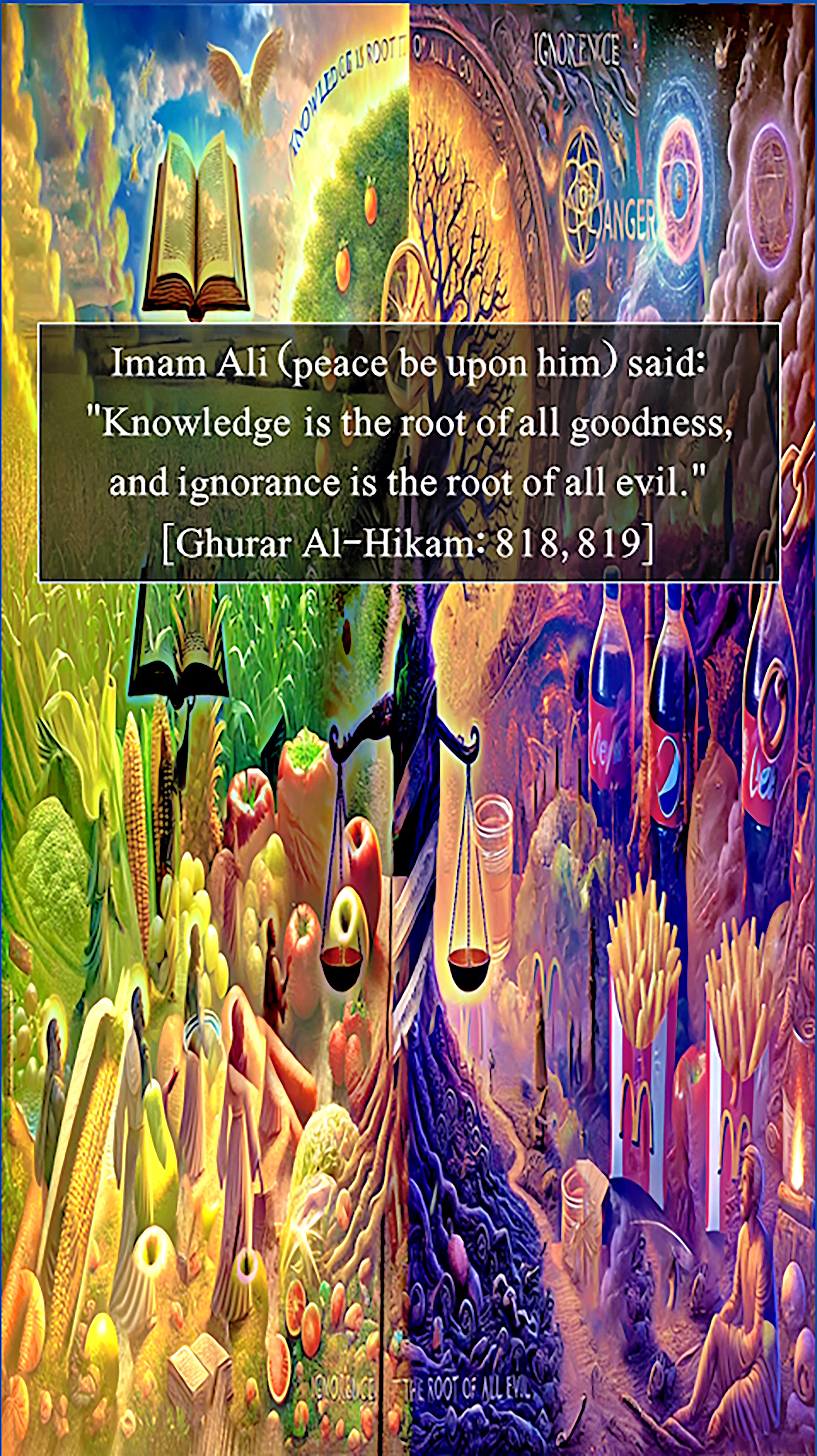
Imam Hasan (peace be upon him) expressed astonishment at those who meticulously guard the cleanliness and purity of their physical food while remaining indifferent to their spiritual nourishment, allowing "deviational, low meanings" to enter their minds and hearts. Imam Ali (peace be upon him) similarly noted: "I am amazed at the people who turn on the light to see what they eat when they want to dine in the dark but do not care about food for their mind. They do not care to illuminate their intellect with the light of knowledge to be safe from making mistakes out of ignorance and wrong beliefs."
The Transience of Worldly Life
Another layer of meaning emerges from the prophetic tradition that food serves as a parable for worldly existence. Prophet Muhammad (peace be upon him and his family) indicated that the food of humanity is a metaphor for the transient nature of this world. One is to observe how even the most delicious food ultimately becomes waste—a powerful reminder that the pleasures and attachments of this world are fleeting and that one should prepare for the eternal life to come.
Part Two: The Divine Process of Food Production
The Water Cycle and Divine Provision
Verses 25 through 32 of Surah Abasa provide the detailed answer to the implicit question in verse 24, describing the miraculous process through which Allah provides sustenance:
The Pouring of Water (Verse 25)
(Indeed, We poured down abundant water)
The Quran emphasizes that water originates from the sky, descending as rain that brings life to the earth. As Imam Musa al-Kadhim (peace be upon him) explained, all water ultimately comes from the sky, and all water is purifying. The descent is not haphazard but measured— neither so much that it causes destructive floods nor so little that it fails to meet the needs of plants and animals.
A profound narration from Imam Ali ibn Musa al-Rida (peace be upon him) describes the divine wisdom in the gradual descent of rain:
Muhammad ibn al-Qasim al-Astarabadi said: Yusuf ibn Muhammad ibn Ziyad and `ali ibn Muhammad ibn Sayyar both said, on the authority of their father, on the authority of al-Hasan ibn `Ali, on the authority of his father `Ali ibn Muhammad, on the authority of his father Muhammad ibn `Ali, on the authority of his father, `Ali ibn Musa al-Rida, on the authority of his father Musa ibn Ja`far, on the authority of his father Ja`far ibn Muhammad, on the authority of his father Muhammad ibn `Alithat His father, `Ali ibn al-Husayn, was asked to interpret the Word of Allah, the Mighty and High: Who made the Earth a resting place for you. He said He made it suitable for your nature and in harmony with your bodies. He did not make it severely hot and warm so it may burn you, nor severely cold so it may freeze you. Neither did He make it severely perfumed to give you headaches, nor did He make it terribly foul-smelling so it may sicken you. He neither made it severely soft like water so it may drown you, nor did He make it severely hard so it may obstruct you from making houses, buildings, and graves for your deceased. However, Allah, the Mighty and High, made it with firmness so that you could benefit form it, enabling your bodies to walk upon it and your houses to hold together. He placed in it soft soil so that you could build your homes upon it, dig graves, and so that you could find other benefits. This is why He made the earth a resting place for you. Then the Mighty and high said: Heaven a canopy, i.e. a protecting roof over you, where its sun, moon and stars rotate for your benefit. The Mighty and High then said: And (Who sends down water from heaven, i.e. the rain which He sends down form a height so that I may reach the highest points of the mountains, the hills, the elevations, and the low-lying land. Then He separated the rain into drizzle, shower, heavy downpour, and sprinkles so that he earth could better absorb it. He did not sent the rain down in one shot, as that would have destroyed our lands, trees, field and fruits. Then the Mighty and High said: Then brings forth with it subsistence for you of the fruits; therefore, do not set up rivals to Allah, i.e. Images or idols, which cannot think, hear, see, and do not have power over anything. While you know, that they do not have power over the magnificent bounties which your Lord, the Blessed and Exalted, ha blessed you with. (Al-Taw??d by Shaykh Mu?ammad b. ?Al? al-?aduq, Book 2, Chapter 62, ?ad?th #11)
The Splitting of the Earth (Verse 26)
Then We burst the earth, splitting it with sprouts
Following the abundant water, the earth is "split." This splitting is primarily interpreted as the breaking of the soil by tender plant sprouts—a truly wondrous phenomenon where a soft, delicate shoot penetrates the soil and sometimes even breaks through rocks. Most exegetes understand this as one of the greatest marvels of creation: the immense power that Allah has placed within a tiny, fragile seed.
This verse also invites reflection on the preparation of soil through ploughing (whether by humans or worms) and the weathering of rocks over time—processes that ultimately create the conditions for agriculture. All these means, however, are ultimately traceable to divine provision.
The Diversity of Crops (Verses 27-31)
The Quran then enumerates the diverse provisions that emerge from the earth:
Grain: This term encompasses the entire range of grains—wheat, barley, corn, millet, oats, rye, and beans. These are identified as the primary food source for humans and animals. The text emphasizes that if grains become unavailable due to drought, widespread famine and hardship would afflict humanity. Imam al-Sadiq (peace be upon him) specifically clarified that when the Quran speaks of "the food of those who were given the Book" (Quran 5:5), it refers to grains.
Imam Jafar ibn Muhammad Al-Sadiq (peace be upon him), was asked about the saying of Allah (swt), the Almighty and Majestic: And the food of those who were given the Scripture is lawful for you (Quran 5:5).
Imam (peace be upon him) said: It means grains.
(Footnote: Hadith.4218 - Imam Jafar ibn Muhammad Al-Sadiq (peace be upon him), was asked about the saying of Allah (swt), the Almighty and Majestic: And the food of those who were given the Scripture is lawful for you (Quran 5:5).
Imam (peace be upon him) said: It means grains.)
(Man La Yahduruh al-Faqih (Vol. 3) by Shaykh Muhammad b. Ali al-Saduq, Book 2, Chapter 36, Hadith #98)
Grapes and Green Fodder: Grapes are recognized for their nutritional and vital values, serving as wholesome food.
Imam al-Sadiq (peace be upon him) said, "One of the prophets complained of his grief to Allah. So he commanded him to eat grapes. (al-Mahasin, v. 2, p. 362, no. 2262)
Olives and Date-Palms: These are highlighted for their significant nutritional value and diverse utility. Olives and dates have been staple foods and resources for millennia, and the Quran emphasizes their blessed status.
Thick Foliaged Gardens: This describes dense gardens filled with tall, strong trees, evoking images of lushness, abundance, and the rich vegetation of Paradise.
Fruits and Herbage: The term "fakiha— refers to various fruits, while "abb" specifically refers to grass and pasturage for grazing animals. Notably, when Abu Bakr was asked about the meaning of "Al-Abb," he admitted his ignorance. Imam Ali (peace be upon him) clarified that it refers to "feeding and pasturage."
The Purpose of Divine Provision (Verse 32)
A provision and benefit for you and your cattle
This concluding verse states that all these provisions—grains, fruits, vegetables, and fodder—are created for the enjoyment and benefit of both humans and their livestock. This sustenance is a continuous blessing meant to foster perpetual remembrance and gratitude toward Allah. The purpose is for humans to partake of its fruits and be thankful for what they have not directly labored to create.
Part Three: The Spiritual Significance of Specific Foods
The Importance of Grains
Islamic teachings emphasize the fundamental importance of grains as a divine favor. Without grain, the text states, "kings would hoard it as they hoard gold and silver." This highlights the immense value of grain and its role in preventing widespread hardship.
Imam al-Sadiq (peace be upon him) emphasized that grains are the primary meaning of "food" in the verse permitting Muslims to eat from the food of the People of the Book (Surah Al- Ma'idah, 5:5). He clarified that this permissibility extends to cereals and fruits, but not to the slaughtered animals of the People of the Book, because they do not typically mention the Name of Allah during slaughter.
Imam Jafar ibn Muhammad Al-Sadiq (peace be upon him), was asked about the saying of Allah (swt), the Almighty and Majestic: And the food of those who were given the Scripture is lawful for you (Surah Al-Ma'idah, 5:5).
Imam (peace be upon him) said: It means grains.
(Footnote: Hadith.4218 - Imam Jafar ibn Muhammad Al-Sadiq (peace be upon him), was asked about the saying of Allah (swt), the Almighty and Majestic: And the food of those who were given the Scripture is lawful for you (Surah Al-Ma'idah, 5:5).
Imam (peace be upon him) said: "It means grains.") (Man La Yahduruh al-Faqih (Vol. 3) by Shaykh Muhammad b. Ali al-Saduq, Book 2, Chapter 36, Hadith #98)
Grapes hold a significant position in Islamic tradition. The Quran mentions grapes in multiple contexts, highlighting their dual nature as a source of nourishment and their potential to produce intoxicants—a duality that served as an indirect hint in the gradual prohibition of alcohol.
Imam Jaffar Sadiq (peace be upon him): Imam al-Sadiq (peace be upon him) said, "One of the prophets complained of his grief to Allah. So he commanded him to eat grapes." (al-Mahasin, v. 2, p. 362, no. 2262)
Prophet (s) taught a specific etiquette for consuming grapes: “Eat grapes one by one, for it is more wholesome and easier." (Warram ibn Abi Firas al-Maliki al-Ashtari Uyun akhbar al-Rida (Vol. 2) by Shaykh Muhammad b. Ali al-Saduq, Book 1, Chapter 1, Hadith #82)
A particularly moving tradition illustrates the generosity and selflessness of Imam Zayn al-Abidin (peace be upon him). While fasting, he repeatedly gave away bunches of fresh grapes to beggars, even when they were bought back and returned to him. This happened three times before he finally ate on the fourth instance—demonstrating his prioritization of the needy over his own desires.
Ali ibn Ibrahim has narrated from his father from ibn abu ‘ Umayr from Hisham ibn Salim who has said the following: “Ali ibn al-Husayn, ‘Alayhim al-Salam, liked grapes. One day he fasted and when it was the time to break his fast, the first thing that was brought to him was grapes. A mother of his child brought a bunch of grapes and placed before him. A beggar came and he (the Imam) give it to him. The mother of his child managed to buy it secretly from the beggar. She then placed it before him (the Imam). Another beggar came and he (the Imam) give it to the beggar. The mother of his child again secretly bought it from the beggar. She placed it before him (the Imam). Another beggar came and he (the Imam) give it to the beggar and she again secretly bought and placed it before him (the Imam). In the fourth time he (the Imam) (peace be upon him), was able to eat it.’”— Al-Kafi (Vol. 6) by Shaykh Muhammad b. Yaqub al-Kulayni, Book 5, Chapter 99, Hadith #3
The Blessed Tree: Olives
The olive is repeatedly emphasized in the Quran and traditions as a blessed tree. The Quran itself swears by the fig and the olive (Surah At-Tin, 95:1). The medicinal and nutritional benefits of olives and olive oil are extensive:
The Messenger of Allah (peace be upon him and his family) said: "Olives are the rubbing oil of the virtuous ones and the sauce of the selected ones. It was blessed when coming as well as returning (plentiful or scarce) and immersed in holiness twice.” (Al-Kafi (Vol. 6) by Shaykh Muhammad b. Yaqub al-Kulayni, Book 5, Chapter 80, Hadith #6)
Amir al-Mu'minin (peace be upon him) advised: "Use olives for rubbing and as sauce; it is the rubbing oil of the virtuous people and the sauce of the chosen ones. It was touched with holiness twice and it was blessed when coming and returning (plentiful or scarce) and with it illness does not harm.”’ (Al-Kafi (Vol. 6) by Shaykh Muhammad b. Yaqub al-Kulayni, Book 5, Chapter 80, Hadith #4)
Olive oil is described as an appetite stimulant, a preserver, and a cure for physical pains.
It is believed to protect against illness—Amir al-Mu'minin (peace be upon him) stated that "Use olives for rubbing and as sauce; it is the rubbing oil of the virtuous people and the sauce of the chosen ones. It was touched with holiness twice and it was blessed when coming and returning (plentiful or scarce) and with it illness does not harm.” (Al-Kafi (Vol. 6) by Shaykh Muhammad b. Yaqub al-Kulayni, Book 5, Chapter 80, Hadith #4)
The Comprehensive Benefits of Dates
Date palms are mentioned approximately twenty times in the Quran, indicating their profound importance. The date palm tree is associated with the Prophet Adam (peace be upon him) and is described as resembling a believer in its steadfastness and continuous benefit.
The nutritional and medicinal benefits of dates are extensive:
Dates contain sugar, fat, proteins, essential vitamins (B6, folic acid, vitamin A), and numerous minerals (calcium, potassium, phosphorus, iron, magnesium, copper, and more).
They strengthen bones, improve eyesight and hearing, and are effective in preventing abdominal cancer.
Dates are an energetic food that takes away fatigue and satisfies hunger.
Specific varieties hold special significance. Al-Barni dates were praised by the Prophet (s.a.w.w.) for having nine characteristics, including improving both hearing and sight, strengthening the back, and bringing one closer to Allah.
Ali ibn Abi Talib (peace be upon him) said, “Gabriel (peace be upon him) descended to the Prophet (S) and said, I advise you to eat ‘barni’ dates as they are the best type of your dates. That will help you get closer to the Honorable the Exalted God and get more distant from the Fire.” — Uyun akhbar al-Rida (Vol. 2) by Shaykh Muhammad b. Ali al-Saduq, Book 1, Chapter 1, Hadith #135
Bread holds an exceptionally honorable status in Islamic teachings. Its significance is rooted in the belief that its creation involves the entire cosmos, pay respect to bread, for all those beings living between the Divine Throne and the earth have worked on it.
The Messenger of Allah (s.a.w.w.) stated:
"O Allah, bless us through bread and do not keep us and bread distanced; because if there is no bread, neither we would be able to pray nor fast and neither carry out any other obligation."
A number of our people have narrated from Ahmad ibn abu ‘Abd Allah from his father from abu al-Bakhtariy in a marfu‘ manner has said the following: “The Messenger of Allah, O Allah, grant compensation to Muhammad and his family worthy of their services to Your cause, has said, ‘O Lord, grant us blessings in bread and do not separate it from us. If bread had not been available, we could not fast or perform Salat (prayer) or fulfill any of our obligation toward our Lord, most Majestic, most Glorious.”’ — Al-Kafi (Vol. 6) by Shaykh Muhammad b. Yaqub al-Kulayni, Book 5, Chapter 41, Hadith #6
This sacred origin of bread demands that it be treated with utmost respect. The Prophet (s.a.w.w.) taught:
Bread should be broken by hand, not cut with a knife.
One should never smell bread like beasts do.
Bread should not be trodden upon.
Eating should begin with bread to reduce the intensity of hunger.
Bread should be baked in small loaves as there is divine increase in it.
Ali ibn Ibrahim has narrated from his father from al-Nawfaliy from al-Sakuniy who has said the following: “Abu ‘Abd Allah (peace be upon him), has said that the Messenger of Allah, O Allah, grant compensation to Muhammad and his family worthy of their services to Your cause, has said, ‘You must never smell bread like the beasts do. Bread is blessed and Allah, most Majestic, most Glorious, has sent the sky with rain and because of it He has grown the pastures. By means of bread you perform Salat (prayer), observe fast and perform al-Hajj of the House of your Lord.’”— Al-Kafi (Vol. 6) by Shaykh Muhammad b. Yaqub al-Kulayni, Book 5, Chapter 50, Hadith #6
Part Four: Food, Intellect, and Spiritual Growth
The Connection Between Diet and Cognitive Function
Islamic traditions extensively discuss foods that benefit the intellect, memory, and cognitive abilities. These teachings reflect a holistic understanding that physical nourishment directly impacts mental and spiritual well-being.
Foods Believed to Enhance Intellect
Calabash/Gourd/Pumpkin: The Holy Prophet Muhammad (peace be upon him and his family) recommended eating gourd, stating it "increases in the brain and the intellect."
A number of our people have narrated from Ahmad ibn abu ‘Abd Allah from his father from certain persons of our people who has said the following: “Abu al-Hassan, Musa (peace be upon him), has stated this Hadith. ‘Of the things about which the Messenger of Allah, O Allah, grant compensation to Muhammad and his family worthy of their services to Your cause, recommended Ali (peace be upon him), was his saying, ‘O Ali, you must eat gourd, squash; it increases, al-Damagh, the abilities of the brain and the power of reason.’” — Al-Kafi (Vol. 6) by Shaykh Muhammad b. Yaqub al-Kulayni, Book 5, Chapter 123, Hadith #7
Imam Ali (peace be upon him) advised: “When you cook use a lot of gourds since it strengthens mental powers.” — Uyun akhbar al-Rida (Vol. 2) by Shaykh Muhammad b. Ali al-Saduq, Book 1, Chapter 1, Hadith #87
Frankincense: The Messenger of God (s.a.w.a.) said: "You should have frankincense; for, it increases one's intellect, raises the mind's intelligence, clarifies the vision and eliminates forgetfulness." Chewing frankincense is also recommended to increase memory and do away with phlegm.
From Ja'far bin Muhammad, from his forefathers (peace be upon them), in the Prophet's (peace be upon him and his family) advice to Ali (peace be upon him), he said: O Ali, three things increase memory and remove phlegm: frankincense, using the miswak (tooth stick), and reciting the Quran. O Ali, using the miswak is from the Sunnah, it purifies the mouth, brightens the eyesight, pleases the Most Merciful, whitens the teeth, removes decay, strengthens the gums, increases appetite for food, removes phlegm, increases memory, multiplies good deeds, and delights the angels.— Wasa'il al-Shia Vol. 2, Section 1, Chapter 1, Hadith 1316
Honey: Honey is repeatedly mentioned as a remedy for memory and overall health. The Quran states that in honey "there is healing for men."
Ali ibn Abi Talib (peace be upon him) said, “Three things improve the memory and eliminate phlegm: Reciting the Qur’an, honey and chewing frankincense.” — Uyun akhbar al-Rida (Vol. 2) by Shaykh Muhammad b. Ali al-Saduq, Book 1, Chapter 1, Hadith #111
Vinegar: Imam al-Sadiq (peace be upon him) stated: "Vinegar strengthens the power of understanding."
Ali ibn Ibrahim has narrated from his father from Ibn Abi ‘Umayr from Hisham ibn Salim from Sulayman ibn Khalid who has said the following: “Abu ‘Abd Allah (peace be upon him), has said, ‘Vinegar strengthens the power of understanding.’” — Al-Kafi (Vol. 6) by Shaykh Muhammad b. Yaqub al-Kulayni, Book 5, Chapter 78, Hadith #2
Imam al-Rida (peace be upon him) confirmed that "vinegar strengthens the mind and increases the ability to understand."
Ali ibn Muhammad ibn Bandar has narrated from his father from Muhammad ibn Ali al-Hamadaniy who has said the following: “A man in Khurasan once was with al-Rida’ (peace be upon him), and the table-spread with food inside, vinegar and salt, was brought to him. He (the Imam) began with vinegar and the man said, ‘I pray to Allah to keep my soul in service for your cause, have you commanded us to begin with salt?’ He (the Imam) said, ‘This is like that’, meaning vinegar, ‘and that vinegar strengthens the mind and increases the ability to understand.’” — Al-Kafi (Vol. 6) by Shaykh Muhammad b. Yaqub al-Kulayni, Book 5, Chapter 78, Hadith #4
Other Beneficial Foods: Chickpeas, lentils, broad beans, pomegranate, currants, saffron, and beetroot are all mentioned among foods beneficial for memory and intellect.
Foods to Avoid
Certain foods are cautioned against for their potential negative effects on memory and cognitive function:
Cheese
Sour apples
Coriander
Beef (advised to be avoided)
The Role of Moderation
Islamic teachings emphasize that excessive eating impairs intellectual and spiritual faculties. Prophet Muhammad (peace be upon him and his family) stated: “Nothing is more despised by God than overeating.”— Uyun akhbar al-Rida (Vol. 2) by Shaykh Muhammad b. Ali al-Saduq, Book 1, Chapter 1, Hadith #89
Prophet Mohammad (SAWW) said, ‘Eat when you desire and stop while you still desire.’ — Bihar al-Anwar, v. 62, p. 290
Imam Ali (peace be upon him) noted: ‘Overeating is the greatest aid to acts of disobedience.’ — Ghurar al-?ikam. no. 9922
Imam Ja?far al-Sadiq (peace be upon him) advised dividing the stomach into three parts: one-third for food, one-third for drinks, and one-third for breathing. This guidance prevents overeating and its negative consequences on the mind and spirit.
Muhammad ibn Yahya has narrated from Ahmad ibn Muhammad from ibn Sinan from Salih al-Niliy who has said the following: “Abu ’Abd Allah (peace be upon him), has said, ‘Allah, most Majestic, most Glorious, hates overeating.’ Abu ‘Abd Allah (peace be upon him), has said, ‘Children of Adam must eat to keep their backs straight. When one of you eats keep one-third of your stomach for food one-third for water and one-third for breathing and never become fat like pigs to be slaughtered.’”— Al-Kafi (Vol. 6) by Shaykh Muhammad b. Yaqub al-Kulayni, Book 5, Chapter 21, Hadith #9
The Spiritual Consequences of Overeating
Islamic teachings warn extensively against overeating, identifying it as both a physical and spiritual ailment:
Spiritual Hardening: Prophet Mohammad (SAWW) said, ‘A man whose [consumption of] food is little has a healthy stomach and a pure heart, and a man whose food is plenty has a sickly stomach and a hard heart.’ — Tanbih al-Khawatir, v. 1, p. 46
Hindrance to Worship: Excessive food "slows the limbs in performing acts of obedience" and "blocks the souls from hearing counsel."
Prophet Mohammad (SAWW) said, ‘Be warned against excessive food, for it poisons the heart with hardness, slows the limbs in performing acts of obedience, and blocks the souls from hearing counsel.’ — Bihar al-Anwar, v. 77, p. 182, no. 10
Divine Displeasure: Prophet Muhammad (peace be upon him and his family) said: "Nothing is despised by Almighty Allah more than a full stomach."
God’s Prophet (S) said, “Nothing is more despised by God than overeating.” — Uyun akhbar al-Rida (Vol. 2) by Shaykh Muhammad b. Ali al-Saduq, Book 1, Chapter 1, Hadith #89
Imam Ali (peace be upon him) said: ‘Overeating is the greatest aid to acts of disobedience.’ — Ghurar al-?ikam no. 9922
Imam Ali (peace be upon him) said, ‘Overeating spoils piety.’ — Ghurar al-?ikam no. 659
Physical Illness: Overeating and obesity is linked to various diseases.
Part Five: Food, Knowledge, and the Sources of Guidance
The Allegorical Interpretation of Food as Knowledge
The profound interpretation of "food" as knowledge, particularly from the Imams of the Ahl al-Bayt (peace be upon him), transforms the understanding of this verse into a comprehensive directive for spiritual and intellectual discernment.
Imam Muhammad al-Baqir (peace be upon him) explained that the "food" in this verse refers to the knowledge one acquires and from whom one acquires it.
A number of our people has narrated from Ahmad ibn Muhammad ibn Khalid from his father from one he mentioned from Zayd al-Shahham from abu Ja’far (peace be upon him) who has said the following. “It is his knowledge that he acquires from whoever he acquires.” This he said in answer to the question ‘What is his food’ in the words of Allah, “Let the human being think about (how We produce) his food.” (80:24)?’ — Al-Kafi (Vol. 1) by Shaykh Muhammad b. Yaqub al-Kulayni, Book 2, Chapter 16, Hadith #8
Imam Ali (a.s) said: Be aware! Knowledge without thinking has no profit! Be aware! Recitation of the Qur’an without reflection is of little use! Be aware! Worship lacking reflection has no effect! — 1. Al-Kafi, Volume One, Page 36 and Tuhaful Uqul, Maani Al-Akhbar, page 226; Bihar Al-Anwar Volume 2, page 48-49, Aalamu Addeen, page 100, Mishkat Al-Anwar 137-138, Muniat Almureed 162.
The Source of Knowledge and Its Impact
The teachings of the Ahl al-Bayt (peace be upon him) emphasize that just as the body requires physical sustenance, the soul and intellect require spiritual nourishment in the form of knowledge. The quality of this knowledge—its purity, reliability, and truthfulness—determines the health of the soul.
Unhealthy education and misguidance are like poisonous food, risking one's spiritual life. Therefore, understanding and scrutinizing the source of knowledge is paramount. The Imams of the Ahl al-Bayt (peace be upon him) are identified as the authoritative and pure source of Islamic teachings and guidance, essential for spiritual growth and development.
Imam Hasan (peace be upon him) expressed wonder at those who meticulously care for the hygiene and cleanliness of their physical food to avoid harm yet fail to ponder their spiritual matters and allow "deviational, low meanings" to enter their minds and hearts.
Imam Hasan (peace be upon him) said: I am surprised over the person who thinks about the things he eats (so that those are hygienic & clean) how does he not think & ponder about his spiritual (matters) so he avoids the harmful foods to enter his stomachs but his chest (mind) becomes the rendezvous of deviational, low meanings — Safina Tul Bihar Vol. 2, P 84
Part Six: Food and the Argument for Resurrection
The Resurrection of the Earth as a Paradigm
The most profound theological implication of reflecting on food is its power as an argument for the Resurrection. The Quran consistently uses the revival of dead land through rain and the growth of plants as a paradigm for the resurrection of human beings:
"And of His signs is that you see the earth barren, but when We send down water upon it, it stirs and swells and grows every splendid kind. Indeed, He who has given it life is the Giver of Life to the dead. Surely He is Powerful over everything." (Quran 41:39)
"And it is Allah who sends the winds, and they stir the clouds, and We drive them to a dead land and give life thereby to the earth after its lifelessness. Thus is the Resurrection." (Quran 35:9)
The parallel is undeniable and compelling: just as the earth, dry and lifeless, comes alive with rain and produces abundant vegetation, so too will the dead be raised from their graves. The process of growth from the earth—the splitting of the soil by a tender sprout —is the most vivid and accessible demonstration of divine power over life and death.
The Quran argues from the initial creation to the possibility of recreation:
"And He it is Who originates creation, then He will repeat it, and this is easier for Him." (Quran 30:27)
"Say: He Who brought them into existence in the first instance will give them life again." (Quran 36:79)
If Allah was able to create humans from nothing—or from a simple, lifeless drop of fluid —then recreating them after death is well within His power. Imam Ali (peace be upon him) expressed astonishment at those who deny the Resurrection while witnessing the first creation: "I am amazed at one who denies the Return while seeing the First Creation."
The Quran asserts that creation is not futile or without purpose:
"Did you think that We created you in vain and that you would not be returned to Us?" (Quran 23:115)
The intricate system of food production—from the descent of rain to the growth of diverse crops—demonstrates the wisdom and purpose of divine creation. If life ended in death with no accountability, creation would be meaningless. Therefore, the Resurrection and the Day of Judgment are necessary consequences of a wise and just Creator.
The Cycle of Life and Death as Constant Reminder
Every season, every harvest, and every meal provides a reminder of the cycle of life and death:
The seed that appears dead but springs to life
The earth that is barren and then flourishes
The cycle of growth, decline, and renewal
These natural phenomena are not merely biological processes but divine signs. As Prophet Muhammad (peace be upon him and his family) said when asked about the sign of the Resurrection in creation: "Have you not passed by a land that was dry and dead, and then you passed by it when it had become green? Allah brings the dead to life in this manner, and this is the sign of it in creation."
Part Seven: Practical Implications for Daily Life
Mindful Eating
The verse invites a new relationship with food—one based on mindfulness, gratitude, and reflection. When one eats, they are encouraged to consider:
The origin of the food: Where did this come from? How did it reach me?
The process of creation: The water, the soil, the sun, the growth
The divine power behind it: Who created the system that made this possible?
The spiritual significance: Is this sustenance lawful? Is it pure? Am I grateful?
Islamic tradition provides detailed etiquettes of eating that transform a daily necessity into an act of worship:
- Begin with the Name of Allah: Reciting "Bismillah" (In the name of Allah) before eating invites divine blessings and repels satanic influence.
- End with Praise: Reciting "Alhamdulillah" (All praise is due to Allah) after eating expresses gratitude and acknowledges the source of provision.
- Eat with the Right Hand: Following the practice of Prophet Muhammad (peace be upon him and his family).
- Eat from What is Nearest: Avoid picking from the far side of the communal dish.
- Chew Food Well: This aids digestion and prevents overeating.
- Avoid Overeating: One should stop while still having appetite to eat.
- Share Food: Eating together and sharing with others brings blessings.
Prophet Muhammad (s.a.w.a.) said: "When the table is set, four angels surround it. If the servant says 'Bismillah,' the angels say to Satan, 'Be gone, O wicked one, for you have no authority over them.' But if they finish eating and say 'Alhamdulillah,' the angels say, 'They are a people whom Allah has blessed, and they have expressed gratitude to their Lord.'"
It is narrated by Isma'il ibn Abi Ziyad, from Abu Abdullah Imam Jafar ibn Muhammad Al-Sadiq (peace be upon him) that the Messenger of Allah (swt), peace and blessings be upon him and his family, said: When the table (for food) is set, four angels surround it.
If the servant says 'In the name of Allah (swt),' the angels say to Satan, 'Be gone, O wicked one, for you have no authority over them.'
But if they finish eating and say 'Praise be to Allah (swt),' the angels say, 'They are a people whom Allah (swt) has blessed, and they have expressed gratitude to their Lord (azj).'
However, if they do not say 'In the name of Allah (swt),' the angels say to Satan, 'Come closer, O wicked one, and eat with them.'
And if they do not praise Allah (swt) when they finish, the angels say, 'They are a people whom Allah (swt) has blessed, but they forgot their Lord (azj).'
(Footnote: Hadith.4250 - It is narrated by Isma'il ibn Abi Ziyad, from Abu Abdullah Imam Jafar ibn Muhammad Al-Sadiq (peace be upon him) that the Messenger of Allah (swt), peace and blessings be upon him and his family, said: "When the table (for food) is set, four angels surround it. And if they do not praise Allah (swt) when they finish, the angels say, They are a people whom Allah (swt) has blessed, but they forgot their Lord (azj).')" (Man La Yahduruh al-Faqih (Vol. 3) by Shaykh Muhammad b. Ali al-Saduq, Book 2, Chapter 37, Hadith #15)
Lawful Sustenance and Its Impact
The permissibility (halal) and purity (tayyib) of food have profound spiritual consequences. The Quran instructs:
"O you who have faith! Eat of the good things We have provided for you, and be grateful to Allah, if it is Him you worship." (Quran 2:172)
Consuming lawful and pure food impacts one's character, spiritual state, and acceptance of guidance. The Messenger of Allah (peace be upon him and his family) advised: "Keep your food halal (pure), and do not let anything haram (unlawful) enter your stomach," for one's supplications to be answered.
Conversely, consuming unlawful food can have negative spiritual consequences, potentially leading to the influence of Shaytan and hindering one's spiritual development.
Part Eight: The Deeper Spiritual Dimensions
Food as a Mirror of the Soul
The interpretation of food as knowledge—and the directive to "look at" its source— illuminates the deep connection between what we consume physically and what we consume intellectually and spiritually.
Just as food enters the body and becomes part of one's physical existence, knowledge enters the mind and shapes one's worldview, beliefs, and character. The purity of both is essential for human flourishing.
The Role of Food in Spiritual Development
Food, in Islamic tradition, is not merely a material necessity but a vehicle for spiritual growth:
Gratitude: Reflecting on food cultivates thankfulness to Allah.
Humility: Recognizing that one depends on sustenance from others and, ultimately, from God.
Awareness: Understanding the interconnectedness of all creation.
Spiritual Nourishment: Just as the body requires food, the soul requires knowledge and remembrance of Allah.
The connection between physical consumption and spiritual states is profound. Overeating leads to spiritual hardness, while moderation maintains a soft and receptive heart. Prophet Muhammad (peace be upon him and his family) taught: "The heart bears wisdom when the stomach is empty, and the heart throws out wisdom when the stomach is full." (Tanbih al-Khawatir, v. 2, p. 119)
Imam Ali (peace be upon him) stated: "When the stomach is filled with [even] permissible food, the heart becomes blind to goodness." (Ghurar al-Hikam, no. 4139
)
These teachings demonstrate that the state of one's stomach directly affects one's spiritual perception and receptivity to divine guidance.
Conclusion: The Comprehensive Vision of Quran 80:24
The verse "Then let man look to his food" stands as a comprehensive directive for human reflection and growth. It invites humanity to:
Look at Physical Sustenance: Contemplate the miraculous process by which water, soil, and seeds combine to produce the food that sustains life. Recognize the divine power and wisdom behind this everyday miracle.
Look at Spiritual Sustenance: Examine the sources of knowledge and guidance that nourish the soul. Ensure that what enters the mind and heart is pure, lawful, and authoritative.
Look at the Evidence for the Resurrection: See in the revival of dead land a sign of the revival of human beings after death. Recognize that the power that brings life to the earth is the same power that will bring life to the dead.
Look at One's Purpose: Understand that sustenance is not merely for physical survival but for fulfilling one's role as a servant of God, preparing for the eternal life to come.
The reflection on food, therefore, is not an isolated act but a gateway to comprehensive awareness—awareness of the Creator, of oneself, of one's purpose, and of one's ultimate destiny. It transforms the simple act of eating from a mundane necessity into an act of worship, gratitude, and deep spiritual connection.
In the words of Imam Ali (peace be upon him), "Be aware! Knowledge without thinking has no profit!
Be aware! Recitation of the Qur’an without reflection is of little use!
Be aware! Worship lacking reflection has no effect!"( Al-Kafi, Volume One, Page 36 and Tuhaful Uqul, Maani Al-Akhbar, page 226; Bihar Al-Anwar Volume 2, page 48-49, Aalamu Addeen, page 100, Mishkat Al-Anwar 137-138, Muniat Almureed 162.)
"O Allah, bless us in what You have provided for us, and protect us from the punishment of the Fire."
Quranic Verses
1. Surah Abasa (80:24) - "Then let man look to his food"
2. Surah Abasa (80:25-32) - Description of divine provision through water, earth, and vegetation
3. Surah Abasa (80:25) - "Indeed, We poured down abundant water"
4. Surah Abasa (80:26) - "Then We burst the earth, splitting it with sprouts"
5. Surah Abasa (80:27-31) - Enumeration of diverse crops and provisions
6. Surah Abasa (80:32) - "A provision and benefit for you and your cattle"
7. Surah Al-Ma'idah (5:5) - "And the food of those who were given the Scripture is lawful for you"
8. Surah At-Tin (95:1) - Swearing by the fig and the olive
9. Surah Fussilat (41:39) - "And of His signs is that you see the earth barren, but when We send down water upon it, it stirs and swells..."
10. Surah Fatir (35:9) - "And it is Allah who sends the winds, and they stir the clouds, and We drive them to a dead land..."
11. Surah Ar-Rum (30:27) - "And He it is Who originates creation, then He will repeat it..."
12. Surah Ya-Sin (36:79) - "Say: He Who brought them into existence in the first instance will give them life again"
13. Surah Al-Mu'minun (23:115) - "Did you think that We created you in vain and that you would not be returned to Us?"
14. Surah Al-Baqarah (2:172) - "O you who have faith! Eat of the good things We have provided for you..."
Hadith and Traditions
From Al-Kafi by Shaykh Muhammad b. Yaqub al-Kulayni
1. Book 1, Chapter 16, Hadith #8 - Imam Muhammad al-Baqir (peace be upon him) on "food" as knowledge: "It is his knowledge that he acquires from whoever he acquires."
2. Book 5, Chapter 99, Hadith #3 - Narration about Imam Zayn al-Abidin (peace be upon him) giving away grapes repeatedly while fasting
3. Book 5, Chapter 80, Hadith #6 - The Messenger of Allah (peace be upon him and his family) on olives: "Olives are the rubbing oil of the virtuous ones..."
4. Book 5, Chapter 80, Hadith #4 - Amir al-Mu'minin (peace be upon him) on olives: "Use olives for rubbing and as sauce..."
5. Book 5, Chapter 41, Hadith #6 - The Messenger of Allah on bread: "O Lord, grant us blessings in bread..."
6. Book 5, Chapter 50, Hadith #6 - Prohibition of smelling bread like beasts
7. Book 5, Chapter 123, Hadith #7 - Recommendation of gourd/squash: "it increases al-Damagh, the abilities of the brain and the power of reason"
8. Book 5, Chapter 78, Hadith #2 - Imam al-Sadiq (peace be upon him): "Vinegar strengthens the power of understanding"
9. Book 5, Chapter 78, Hadith #4 - Imam al-Rida (peace be upon him): "Vinegar strengthens the mind and increases the ability to understand"
10. Book 5, Chapter 21, Hadith #9 - Imam al-Sadiq (peace be upon him) on dividing the stomach into three parts
From Man La Yahduruh al-Faqih by Shaykh Muhammad b. Ali al-Saduq
11. Book 2, Chapter 36, Hadith #98 - Imam Jafar ibn Muhammad Al-Sadiq (peace be upon him) on the meaning of "the food of those who were given the Scripture" - "It means grains"
12. Book 2, Chapter 37, Hadith #15 - Narration about four angels surrounding the table when food is set
From Al-Tawhid by Shaykh Muhammad b. Ali al-Saduq
13. Book 2, Chapter 62, Hadith #11 - Imam Ali ibn Musa al-Rida (peace be upon him) on the divine wisdom in the gradual descent of rain
From Uyun akhbar al-Rida by Shaykh Muhammad b. Ali al-Saduq
14. Book 1, Chapter 1, Hadith #82 - Prophet (s) on eating grapes: "Eat grapes one by one, for it is more wholesome and easier"
15. Book 1, Chapter 1, Hadith #135 - Gabriel (peace be upon him) advising the Prophet on "barni" dates
16. Book 1, Chapter 1, Hadith #87 - Imam Ali (peace be upon him) on gourds: "When you cook use a lot of gourds since it strengthens mental powers"
17. Book 1, Chapter 1, Hadith #111 - Ali ibn Abi Talib (peace be upon him): "Three things improve the memory and eliminate phlegm: Reciting the Qur'an, honey and chewing frankincense"
18. Book 1, Chapter 1, Hadith #89 - Prophet Muhammad (peace be upon him and his family): "Nothing is more despised by God than overeating"
From Wasa'il al-Shia
19. Vol. 2, Section 1, Chapter 1, Hadith 1316 - From Ja'far bin Muhammad, from his forefathers, on things that increase memory: frankincense, miswak, and reciting the Quran
From Bihar al-Anwar
20. Vol. 62, p. 290 - Prophet Mohammad (SAWW): "Eat when you desire and stop while you still desire"
21. Vol. 77, p. 182, no. 10 - Prophet Mohammad (SAWW): "Be warned against excessive food, for it poisons the heart with hardness..."
From Ghurar al-Hikam
22. No. 9922 - Imam Ali (peace be upon him): "Overeating is the greatest aid to acts of disobedience"
23. No. 659 - Imam Ali (peace be upon him): "Overeating spoils piety"
24. No. 4139 - Imam Ali (peace be upon him): "When the stomach is filled with [even] permissible food, the heart becomes blind to goodness"
From Tanbih al-Khawatir
25. Vol. 1, p. 46 - Prophet Mohammad (SAWW): "A man whose [consumption of] food is little has a healthy stomach and a pure heart..."
26. Vol. 2, p. 119 - Prophet Muhammad (peace be upon him and his family): "The heart bears wisdom when the stomach is empty..."
From Al-Mahasin
27. Vol. 2, p. 362, no. 2262 - Imam al-Sadiq (peace be upon him): "One of the prophets complained of his grief to Allah. So he commanded him to eat grapes"
From Safina Tul Bihar
28. Vol. 2, P 84 - Imam Hasan (peace be upon him) on reflecting on spiritual matters as one reflects on physical food
Other Sources Mentioned
29. Tuhaful Uqul, Maani Al-Akhbar, page 226 - Imam Ali (a.s): "Be aware! Knowledge without thinking has no profit..."
30. Al-Kafi, Volume One, Page 36 - Imam Ali (a.s): "Be aware! Knowledge without thinking has no profit..."
31. Bihar Al-Anwar Volume 2, page 48-49 - On Imam Ali's statement about knowledge without reflection
32. Aalamu Addeen, page 100, Mishkat Al-Anwar 137-138, Muniat Almureed 162 - Additional sources for Imam Ali's statement
Qur'anic verses and hadiths of Ahl al-Bayt (peace be upon them) and sayings in Arabic, Persian and English.
https://eitaa.com/noorunalanoor
https://www.youtube.com/@110Inspire
https://youtube.com/@mustafaabbas4668?si=EnSIkaIECMiOmarE
https://youtube.com/@mustafaabbas8978?si=EMJylUW9_zruJx95